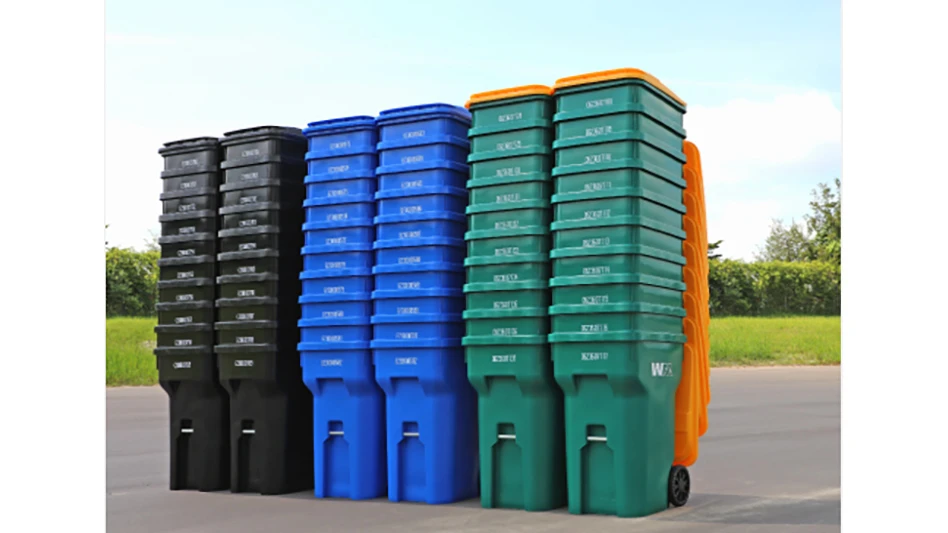
Photo courtesy of Cascade Engineering
Earlier this fall, Cascade Engineering, based in Grand Rapids, Michigan, was selected to supply 3,000 residential municipal solid waste (MSW) carts to the Central Virginia Waste Management Authority (CVWMA). The carts were produced in partnership with UBQ Materials.
According to Israel-based UBQ Materials, which has a U.S. office in Sunny Isles Beach, Florida, the carts will be manufactured by Cascade from a UBQ-developed composite material consisting of harvested MSW residue.
Jack “Tato” Bigio, co-founder and chief growth and sustainability officer at UBQ Materials, describes what makes UBQ material unique and how the partnership with CVWMA and Cascade Engineering came about in the following interview.
Q: What makes UBQ different from other recycled plastics?
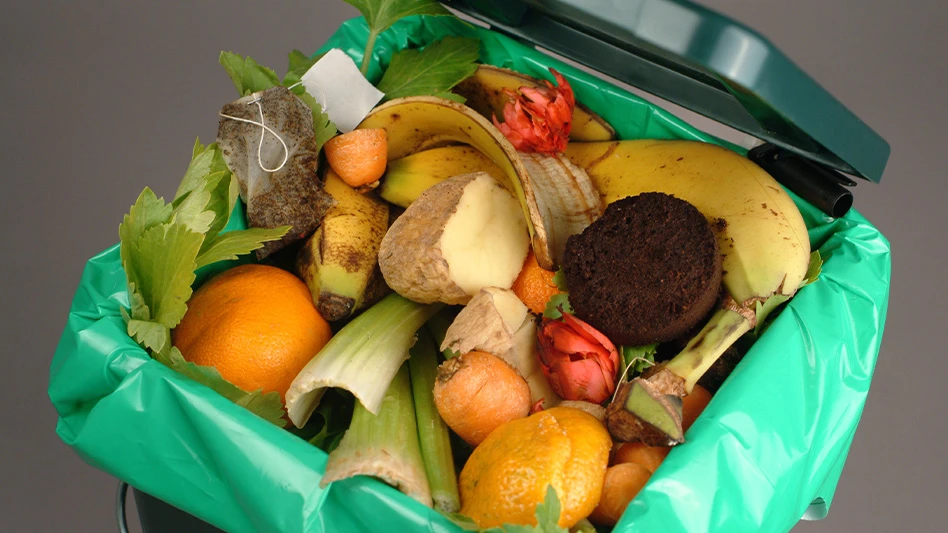
JB: UBQ is not a recycled plastic but an innovative, novel bio-based material. We set ourselves apart by transforming unsorted household waste, including all organics, into a climate-positive, bio-based thermoplastic. Unlike conventional recycled plastics that rely on clean, sorted inputs, UBQ Materials diverts mixed household waste from landfills and offsets carbon emissions through the natural biogenic cycle of its organic content. The production of UBQ material reduces reliance on petroleum-based materials and enables the production of sustainable products without extracting new resources from the planet.
Q: How did Virginia first come to partner with UBQ?
JB: UBQ Materials first launched a pilot project in partnership with the Central Virginia Waste Management Authority in 2019. Building on that foundation, this new initiative aligns with the state’s commitment to strengthening Virginia’s waste management infrastructure. The introduction of circular waste collection bins made with UBQ material further supports CVWMA’s 2024–2044 strategic plan to reduce solid waste and promote the use of sustainable materials. This effort underscores Virginia’s broader dedication to clean air, clean water and vibrant neighborhoods through responsible municipal sourcing.
Q: Did Cascade Engineering have to make any modifications to use the material to manufacture the carts?
JB: Our technical team works closely with our partners to determine the right UBQ material formulation to maintain all performance, quality and aesthetic requirements. Once the material formulation is created, no further modifications are needed. UBQ is compatible with standard production processes, including injection molding—which Cascade utilizes—so no new equipment or reformulation was required. Cascade’s seamless integration of UBQ demonstrates how easily this circular material fits into existing manufacturing.
Q: How much UBQ material will be used to manufacture the 3,000 carts? Will the carts feature 100 percent UBQ material, or will the UBQ material be mixed with other materials?
JB: Waste carts are one of the most demanding products as they are exposed to constant impact and to a wide range of external temperatures. In this production round of 3,000 carts, approximately 5 percent of UBQ material was used in the total cart composition. As we advance the development of new formulations and its implementation in collaboration with Cascade, we expect this amount to increase over time.
Q: Where is the UBQ material produced?
JB: The material for this partnership was produced in UBQ Materials’ state-of-the-art, zero-waste and zero-emissions facility in the Netherlands, which has a closed-loop environment. This partnership further establishes our footprint in the U.S. as part of our strategic vision to scale globally. We are currently advancing the establishment of two plants in two different U.S. states: We aim to have one of these plants operational in early 2028.
Latest from Waste Today
- Fleetio launches AI capability to accelerate fleet maintenance approvals
- Recycle Ann Arbor extends drop-off station operating hours
- Sybilion seeks to help manufacturers confidently address volatility
- Ecowaste Solutions partners with city of Trinity, Texas
- Bristal Hauling acquires G&R Garbage Disposal
- Baltimore trash collection expected to slow as WTE facility closes for maintenance
- Landfill Insights | Connecting the dots: Policy to practice
- FCC Environmental Services awarded collection contract in Florida