The Union Square Partnership (USP), a community-based nonprofit organization in New York City that works to advance the beautification and maintenance of Union Square Park, working in conjunction with The Earth Institute at Columbia University in New York City, has announced the results of a waste characterization study commissioned by the partnership, which equips USP with the data and insights required to accelerate progress toward the city of New York’s OneNYC goals in the Union Square-14th Street neighborhood.
The OneNYC initiative aims to eliminate waste-to-landfill trash citywide by the year 2030. The 0X30 program was launched by Mayor Bill de Blasio in 2015, and its success will depend on the active engagement of the city’s 75 business improvement districts (BIDs).
“In the same way that BIDs have partnered closely with city agencies to maintain our city’s parks and green spaces, create vibrant and secure pedestrian plazas and support our small business community, USP and other BIDs can play a critical role in realizing the city’s zero waste ambitions as we already undertake significant efforts to execute extensive sanitation and waste removal programs,” Jennifer E. Falk, executive director of the USP, says. “This report provides an invaluable baseline information, the basis for crafting a winning strategy to support the city in ending landfill disposal of public trash.”
“Our ongoing relationships with BIDs, such as the Union Square Partnership, are crucial in helping the city achieve its zero waste goals,” Sanitation Commissioner Kathryn Garcia says. “To send zero waste to landfills by 2030, we need to know what’s in the waste stream. Once we know what people are throwing out, effective and relevant programs can be created to successfully divert material that’s best reused, recycled or otherwise given new life. The USP has been our long-term partner, and we applaud their commitment to helping the city reach its goals.”
USP partnered with a team of graduate students from Columbia University’s Sustainability Management program to profile the contents of Union Square’s trash containers. The students, working in a resource recovery facility in Rahway, New Jersey, analyzed the composition of 600 pounds of trash found in 47 bags collected from 19 locations in and around Union Square over a three-day period in April 2018.
The Columbia student team, whose findings were published in a 77-page report titled “Trash Talks: Defining the Next Generation of Sustainable Sanitation Services for Union Square Partnership and the Public Realm,” concluded that if all of the recyclable, compostable and recoverable waste were diverted, the volume of Union Square trash could be reduced by more than 84 percent.
The team found that the largest proportion of Union Square trash—23 percent—consisted of mixed paper material, including paper bags, flyers and newspapers. The next-largest component—amounting to 17 percent—was comprised of hard plastics, such as water bottles and iced-coffee cups. At 15 percent of the total, food scraps represented the third-largest category of waste.
In addition to examining how to improve recycling and waste reduction in public spaces, the partnership works in close cooperation with local businesses to promote commercial and consumer waste reduction. Several local businesses, including Breads Bakery, Dig Inn, Think Coffee, Pret a Manger and Union Square Hospitality Group are taking the initiative to reduce waste and improve sustainability. Last fall, USP connected Breads Bakery to several zero waste and food recovery organizations after the eatery expressed interest in improving the sustainability of its operations. In the ensuing months, USP and the Columbia student team looked into the operational, workforce, product development and marketing implications of Breads’ zero waste initiatives, generating valuable learnings for other food and retail businesses.This study is just the first step in USP’s efforts to build a more sustainable future for the Union Square-14th Street neighborhood. Building on the data and recommendations detailed in the Trash Talks report, USP intends to launch several new sustainable waste initiatives. Later this year, USP plans to host a business forum to connect a wider range of local restaurants, cafes and grab-and-go eateries with the resources and expertise required to reduce waste in their operations. Pilot programs to promote consumer waste reduction, share best practices among businesses and improve diversion rates in public spaces are also being explored.
“The ‘Trash Talks’ waste management project is another example of our Sustainability Management graduate students’ applying their analytical and management skills to solve real-world sustainability problems for clients like the Union Square Partnership,” George Sarrinikolaou, director of the Office of Academic and Research Programs at The Earth Institute at Columbia University.
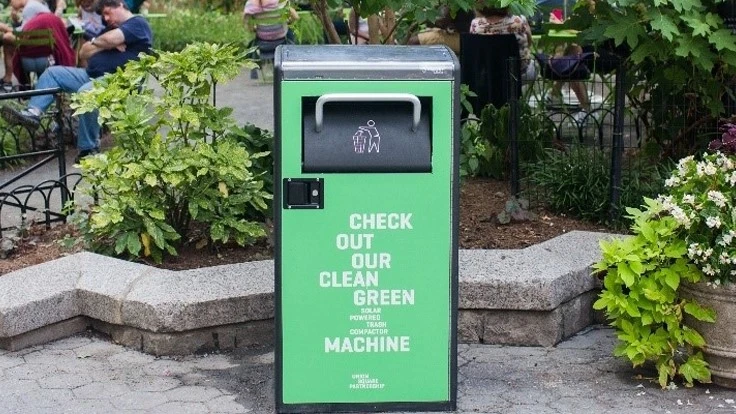
Union Square Park served as the Manhattan location for a public-space recycling pilot program launched by the Department of Sanitation in 2007 and the partnership was the first BID to roll out solar compacting trash receptacles from Big Belly, Needham, Massachusetts, in 2010. It operates park beautification and streetscape beautification programs and hosts several sustainability-themed events throughout the year.
USP spends more than $1 million per year on sanitation services, which represents about a third of its overall financial resources. The district collects more than 178,000 bags of trash, which translates to an estimated 1.6 million pounds of trash generated annually. Roughly 70 percent of the area’s trash is presently sent to landfills. The remaining balance is taken to a New Jersey waste-to-energy plant, owned by the Port Authority of New York and New Jersey where it is converted to electricity.
Latest from Waste Today
- My Green Michigan expands depackaging capacity
- Washington selects Circular Action Alliance as PRO
- Ten-8 Industrial opens new central Florida service center
- Triumvirate Environmental acquires Environmental Waste Minimization
- Official NYC Bin availability expands ahead of deadline
- US Food Waste Pact’s 2025 Impact Report shows decrease in food waste
- Coastal Waste & Recycling expands recycling operations with Machinex
- Reconomy acquires German-based GfAW