Photo by Josh Hawkins and courtesy of UNLV
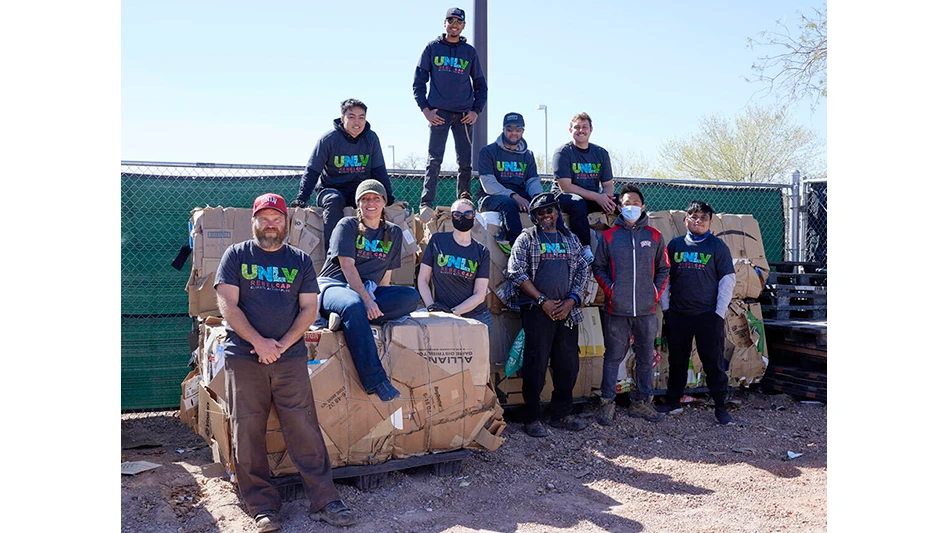
The now 30-year-old Rebel Recycling program that serves the University of Nevada-Las Vegas campus can be traced back to a five-page proposal by Tara Pike, who was a UNLV student in the early and mid-1990s.
Pike, a senior in 1995,worked on laying the groundwork for the project throughout her time at UNLV and, in that span, changed her major from journalism to environmental studies.
“She had a vision that would grow beyond her and transform an entire campus culture,” UNLV staff member Jessie Devine writes in a November article, noting that 30 years later, Rebel Recycling has endured and grown on the campus.
“What began with a $1-per-semester student fee and a lot of manual labor has now become a full-scale materials recovery facility (MRF), a public service hub, a teaching lab and a model for universities across the country.”
By 2002, Pike was honored by United States Environmental Protection Agency (EPA) Region 9, which covers five western states, as a winner of one of its Environmental Heroes awards.
Pike was recognized by the EPA region for expanding volunteer-supported environmental programs at the UNLV, including by overseeing all aspects of recycling at the university, including staffing the program with more than 100 student volunteers each semester.
As of this year, Rebel Recycling provides the UNLV campus with comprehensive waste reduction, recycling and resource management services. Several items the MRF accepts for recycling, including aluminum and steel cans, plastic containers and bottles and numerous types of recovered paper, including books, newspapers, cardboard, office paper, junk mail and cereal boxes.
Rebel Recycling also manages a food waste collection and composting program, a document destruction service and an ink jet toner collection program.
“There was no playbook, just a goal, and we kept trying to just make it happen," Pike says. "That’s what Rebels do.” (Rebels is the nickname for the UNLV athletic teams.)
Pike recounts learning about university budgets and funding during the ensuing three decades and mentions the 2014 delivery of new automated equipment as an important achievement for the program.
“With Rebel Recycling, we created something that didn’t exist, and we’ve done it without the economic incentives that usually drive these programs,” Pike says. “We did it because it was the right thing to do.
“We’ve made it this far because of partnerships and community effort: students, staff, faculty, leadership. Everyone has to be involved for this to succeed.”
Latest from Waste Today
- Fleetio launches AI capability to accelerate fleet maintenance approvals
- Recycle Ann Arbor extends drop-off station operating hours
- Sybilion seeks to help manufacturers confidently address volatility
- Ecowaste Solutions partners with city of Trinity, Texas
- Bristal Hauling acquires G&R Garbage Disposal
- Baltimore trash collection expected to slow as WTE facility closes for maintenance
- Landfill Insights | Connecting the dots: Policy to practice
- FCC Environmental Services awarded collection contract in Florida