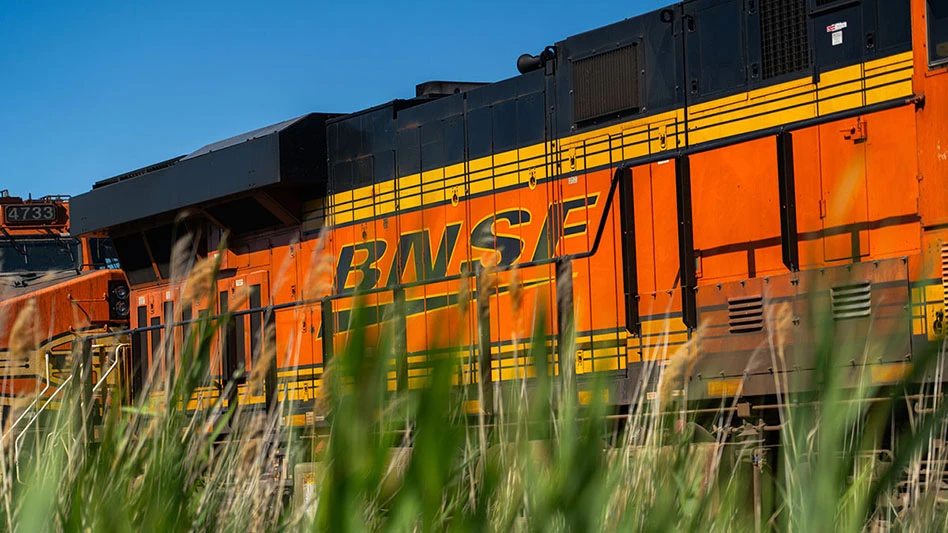
Photo courtesy of BNSF Railway Co.
The president and CEO of Fort Worth, Texas-based BNSF Railway Co. has urged the federal Surface Transportation Board (STB) to ensure shippers using the intermodal freight network can maintain competitive access to that network after a proposed acquisition of Norfolk Southern Corp. (NS) by Union Pacific Corp. (UP).
Last month, BNSF posted information on its website encouraging and helping its customers express opposition concerning that proposed merger of two competing Class 1 freight railroads.
“If you have concerns and reservations about the proposed merger between Union Pacific and Norfolk Southern, or you believe that conditions are needed to ensure that the merger is beneficial to you and other shippers, it is important that the Surface Transportation Board (STB) hear from you now and at every opportunity during the regulatory review process," BNSF says.
Now, BNSF Railway President and CEO Katie Farmer has followed up on comments attributed to a UP representative made at an industry conference earlier this month reportedly stating that more than 300 intermodal lanes will not be closed in cases where there is an origin or destination currently on the BNSF, NS, UP or CSX rail lines if the merger is approved.
Interstate solid waste shippers and recyclers and traders of metal, old corrugated containers and other materials are among the users of intermodal transportation, which connect truck and barge networks with the freight rail network.
“I’m sure the nation’s rail customers are relieved that UP is committing to keep all current intermodal lanes open if their merger with NS is approved,” Farmer says. “UP highlighted in prior rail industry mergers that the new merged railroad usually raises rates on competing interchange partners to the point of making those lanes economically uncompetitive.”
Farmer says the UP announcement is consistent with its position leading up to the 2021 merger between Canadian Pacific and Kansas City Southern, citing a UP filing with the STB before the merger that created Canadian Pacific Kansas City Ltd. (CPKC) was finalized.
“If the [STB] does authorize the transaction, shippers should not have to rely on CPKC’s ‘good faith,'" UP says in that filing. "The board should impose conditions to prevent the reduction of competitive options at gateways, particularly the Laredo [Texas] gateway.
“In short, applicants would face enormous post-merger pressure to divert traffic from existing Kansas City Southern interline service to CPKC single-line service using strategies that reduce shippers’ existing competitive options. CPKC [could] have the ability to implement such anticompetitive strategies by raising rates shippers must pay for interline service or degrading the quality of service shippers receive when using interline service.”
Latest from Waste Today
- Fleetio launches AI capability to accelerate fleet maintenance approvals
- Recycle Ann Arbor extends drop-off station operating hours
- Sybilion seeks to help manufacturers confidently address volatility
- Ecowaste Solutions partners with city of Trinity, Texas
- Bristal Hauling acquires G&R Garbage Disposal
- Baltimore trash collection expected to slow as WTE facility closes for maintenance
- Landfill Insights | Connecting the dots: Policy to practice
- FCC Environmental Services awarded collection contract in Florida