Semi | stock.adobe.com
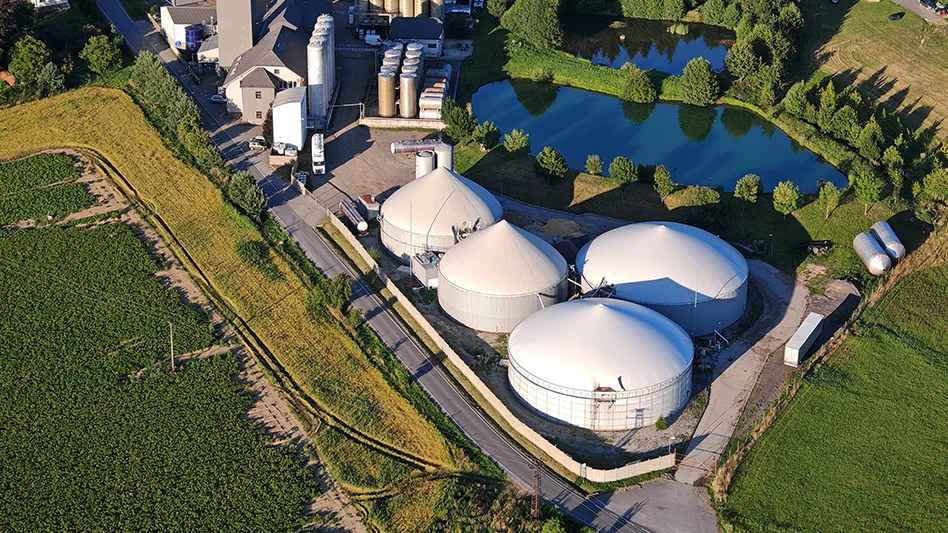
The United States is sitting on a gold mine of renewable natural gas (RNG) if it can manage to fully capture all of the organic waste it produces on a yearly basis, according to the American Biogas Council (ABC).
The Washington-based trade association provided a snapshot of the U.S. biogas industry, estimating that, despite growth in 2025, there’s potential for the country to produce more than 3 trillion cubic feet per year of biogas.
“We exist because of the millions of tons of organic waste that we produce in the U.S. every year and we think that that material should be handled better,” ABC Executive Director Patrick Serfass says. “There’s only really two ways to recycle organic material, and that’s with compost systems and biogas systems. They actually work well together, and biogas systems are going to do a really good job of handling large volumes of waste at a really rudimentary level.”
Capturing that market would require the deployment of $450 billion in capital and 900,000 short-term construction jobs to build 17,000 new biogas capture facilities that would create 43,000 permanent operations jobs.
According to ABC, each year the U.S. produces 120 million dry tons of manure, 12 million dry tons of wastewater biosolids (sludge) and sends more than 24 million tons of inedible food waste to landfills. It added that currently 470 landfills flare their gas that could be captured.
“A lot of benefits there could be realized if we do a better job of capturing all this organic material and recycling it,” Serfass says. “There’s a lot of potential here in nearly every category, enormous growth opportunities everywhere. And that’s just because we have so much waste that we’re producing in the U.S. and could be doing more with that and the gas it produces.”
As of 2025, ABC says there are about 2,585 operational biogas capture systems, including 70 new facilities in 2025, with 599 of them situated at landfills. About 659 of those facilities produce renewable natural gas (RNG) with the remaining 1,453 producing electricity.
The industry saw an 8 percent growth in biogas capture capacity in 2025 with $2.1 billion of new investments that came online, which according to ABC was a 6 percent increase compared to 2024.
Wastewater accounts for 48 percent, or 1,231, of the 2,585 operational systems in the U.S. Landfill accounts for 23 percent and agriculture 24 percent with food waste the remaining 5 percent.
However, in terms of capture capacity, even though landfill only accounts for a fourth of the sites, 72 percent of the total current annual biogas capture capacity is generated from landfills. ABC added that the landfill sector led the way with $912.4 million in capital invested in new facilities for 2025.
“Landfills are just generally very large facilities, especially compared to most anaerobic digesters,” Serfass says. “General rule of thumb is that the smallest landfill is usually an order of magnitude larger than the largest anaerobic digesters. So a lot of gas capture happening in that at landfills, which is obviously really beneficial.”
Heather Dziedic, ABC vice president of policy, says the rise of artificial intelligence (AI) data centers combined with onshoring of domestic manufacturing is driving unprecedented demand for electricity.
Serfass says in the last decade there’s been a massive shift at landfills from generating power to RNG, but he added that might switch back as data center construction drives more demand for reliable power.
Global demand for alternative, lower-carbon marine fuels, increased need to secure domestic supply of fertilizers and global trade policies also are driving demands.
“We’re seeing interest in leveraging what’s available here as RNG as essentially a natural gas substitute for countries that don’t have natural gas domestically,” Dziedic says. “And so we’re seeing exports and interest for exports increase around RNG, leaving the U.S. to be used essentially as natural gas for generation or industry.”
Latest from Waste Today
- ReSource Waste Services acquires C.L. Noonan Container Service
- Synagro, Sedron announce Florida biosolids facility partnership
- RCI selects CurbWaste as exclusive operational management platform
- Terex Ecotec launches TXS 350 Starscreen
- Updated: Supreme Court strikes down IEEPA tariffs
- Fleetio report finds 53.3 percent of fleets researching, piloting AI
- Resources by EWS, Entro Industries launch HSS L65T Landfill Tipper
- NWRA announces 2026 award winners