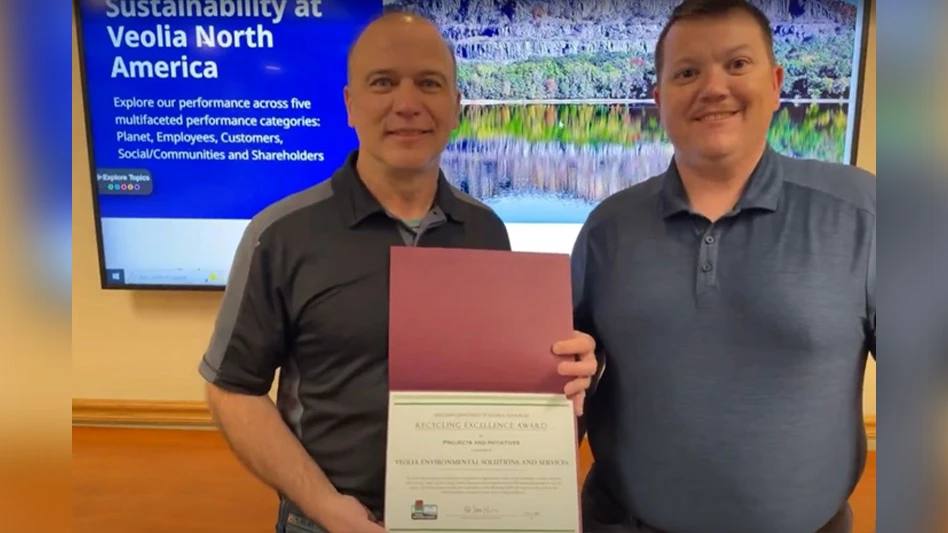
Photo courtesy of Veolia Hazardous Waste North America
The Veolia Hazardous Waste North America team has been awarded the Wisconsin Department of Natural Resources’ Recycling Excellence Award. The team was among 21 organizations to receive the award and was recognized for its program for recycling propane tanks.
“This sustainable solution serves both households and businesses, reducing environmental impact while creating operational efficiencies,” the Wisconsin Department of Natural Resources says in an announcement.
Veolia’s facility in Menomonee Falls, Wisconsin, stores and processes hazardous waste to make the materials safe for proper disposal at an approved land disposal facility. The team developed a gas cylinder recycling unit designed for small and large cylinders.
Working with gas industry experts, Veolia developed a gas recovery system that it says enables 100 percent recovery and recycling of end-of-life propane cylinders. The remaining propane is repurposed and recovered, and the empty metal containers are crushed and sent off-site for reconditioning or recycling.
“I’m extremely proud of everyone on the Menomonee Falls team for showing how Veolia leads the way in bringing sustainable solutions to our customers and communities,” Menomonee Falls Facility Manager Paul Bittner says.
Bittner added that the project’s success was due in large part to Brent Dierks, reactives program manager for the central branch, who guided it forward throughout the process.
“Outstanding work by Brent,” Bittner says. “He was responsible for everything from initiating the project to designing the equipment, developing the standard operating procedure and commencing recycling operations. His vision for this project was guided by the principles of Veolia’s mission of ecological transformation.”
Latest from Waste Today
- Vermeer announces plan to build new facility in Des Moines metro area
- Buffalo Biodiesel shares updates on Part 360 application to DEC, Tonawanda facility progress
- Capstar Disposal expands roll off dumpster rental services
- Supreme Court strikes down IEEPA tariffs
- Casella details facility closures, expansion efforts
- Zero harm: Building a SIF prevention program for waste and recycling operations
- Casella posts a loss in Q4 2025
- McNeilus names Haaker Equipment first Dealer Partner of the Year