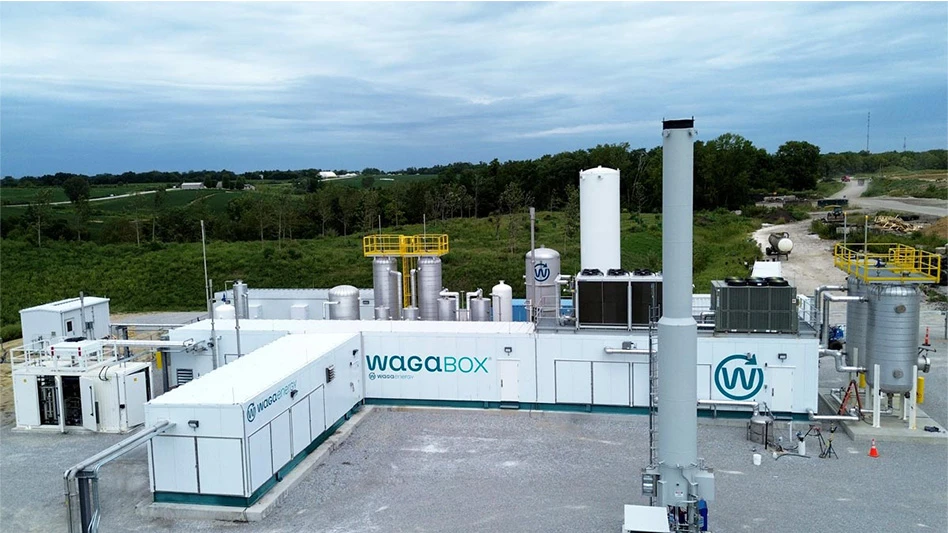
Waga Energy, a France-based environmental services company that specializes in converting landfill gas-to-renewable natural gas (RNG), has commissioned a RNG production facility at the Scott Area Landfill in Davenport, Iowa.
The RNG site uses Waga’s patented Wagabox technology, which is designed to upgrade landfill gas into pipeline-compliant RNG injected directly into the MidAmerican Energy pipeline.
Waga Energy designed, built, owns and operates the plant for a 20-year initial term, sharing revenue with the Waste Commission of Scott County, which operates the Scott Area Landfill, to cover their operational expenses, and with Linwood Mining and Minerals, who leases the property to the commission. Waga Energy says it will support the commission’s ongoing wellfield operations to optimize methane capture and maximize renewable energy production.
“The commissioning of this Wagabox unit at the Scott Area Landfill marks an important step forward for Waga Energy, the community and the commission,” Waga CEO Guénaël Prince says. “Together, we’re turning landfill gas into reliable, local energy, creating value from waste while reducing local emissions. Waga Energy is proud to support the Commission’s vision and to contribute our expertise to a project that demonstrates the power of public-private collaboration in advancing the energy transition.”
The new facility has an installed capacity of more than 205,000 MMBtu (million British thermal units) (60 gigawatt hours) of RNG per year, which Waga says is the equivalent to the energy contained in about 1.5 million gallons of diesel fuel. The firm adds that about 15,800 tons of CO2 equivalent emissions will be avoided annually because of fossil fuel displacement (estimations are based on the U.S. Environmental Protection Agency (EPA) landfill gas energy benefits calculator).
The Scott Area Landfill processes around 185,000 tons of waste annually from 17 municipalities and Scott County, according to Waga. A key pillar for the energy transition, RNG is a local, renewable energy source that can substitute fossil-based fuels in transportation, industry and heating.
“We are excited about this private, public partnership tying directly to the waste commission’s mission of providing sustainable recycling and waste management solutions that positively impact Scott County,” says Bryce Stalcup, Waste Commission of Scott County executive director. “By capturing methane from the Scott Area Landfill and converting it into energy, we’re turning waste into a valuable resource that helps fuel our community and protect our environment.”
Latest from Waste Today
- Commentary: A turning point for flexible plastics recycling
- Hauler Hero raises $16M Series A funding for AI-powered operating system
- EcoATM announces 7.5M devices collected in 2025
- Meridian Waste continues annual contribution to Wake Tech Foundation scholarship
- Sharps Medical Waste Services appoints COO
- NWRA announces 2026 Hall of Fame class
- Maas Energy Works commissions California RNG facility
- Reworld adds to board of directors