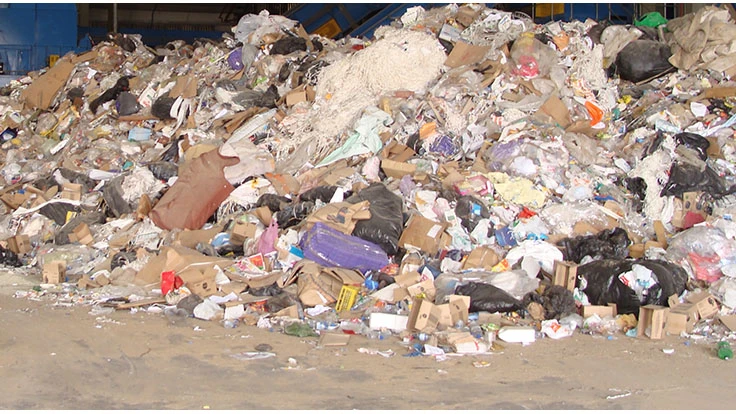
As the economy has improved in California, residents in that state sent more material to landfills in 2015 than in 2014, according to a news release issued by the state’s Department of Resources Recycling and Recovery (CalRecycle) Office of Public Affairs. The disposal increase was accompanied by a drop in the statewide recycling rate.
In 2015, California disposed of 33.2 million tons of material compared with 31.2 million tons in 2014 for residential, business and industry sectors. The new figures mean that Californians disposed, on average, 4.7 pounds per person per day. This is an increase from 4.5 pounds per person per day in 2014, CalRecycle says.
About 40 percent of the increased disposal was organics, such as food waste and grasses. This material readily decomposes and generates greenhouse gases, such as methane.
If the additional 2 million tons of material that went to landfills in 2015 had instead been recycled or composted, CalRecycle says, greenhouse gas emissions would have been reduced by about 2 million metric tons of CO2 equivalent.
Disposal rates generally increase during economic upturns, and California’s statewide diversion rate of 63 percent (the proportion of waste that is diverted from landfills) continues to outpace the 50 percent diversion mandate set in law for local jurisdictions, CalRecycle says. However, increased disposal and missed opportunities to use organics, in particular, challenge California’s ability to achieve environmental goals such as combating climate change.
“The state’s economic resurgence is impressive, but we have to find ways around the barriers to consistent, sustainable reductions in disposal,” says Scott Smithline, director of CalRecycle. “Whether it’s addressing the relatively low cost of disposal or the need to create greater demand for diverted materials, we have to change the equation to one that supports the highest and best end use of discards. Disposal-related greenhouse gases, and the public health and environmental problems they produce, don’t take a break whether the economy is up or down.”
Smithline emphasizes that while landfilling is typically considered cheaper than recycling, the costs of recycling do not accurately reflect the money saved by reduced greenhouse gas emissions; money saved by using recycled feedstock as opposed to virgin feedstock in material production; and the money saved on water and fertilizer for agricultural production when organics are recycled into compost and applied to soil, making it more nutrient-rich and better able to retain moisture. The low cost of dumping recyclables into landfills undercuts all of these benefits, he adds.
AB 341 (Chesbro, Chapter 476, Statutes of 2011) set a statewide goal of 75 percent recycling and required businesses and public entities that generate 4 cubic yards or more of waste each week and multifamily complexes of five units or more to recycle. More recently, AB 1826 (Chesbro, Chapter 727, Statutes of 2014) passed, requiring businesses and multifamily complexes that meet certain thresholds to recycle organics. These two laws, along with other CalRecycle initiatives, are designed to help divert material from landfills.
To increase recycling and composting infrastructure statewide, CalRecycle continues to issue grants and loans and to provide technical assistance for businesses that produce and use recycled feedstock rather than virgin materials. The department has issued a total of $19.5 million in grants to eight businesses through Greenhouse Gas Reduction Fund climate change investments to expand the state’s recycling and manufacturing capacity. CalRecycle also works with other government agencies, the Governor’s Office of Business and Economic Development and other entities to increase market demand for recycled materials and to provide other forms of financing for recycling manufacturing businesses.
Latest from Waste Today
- Vermeer announces plan to build new facility in Des Moines metro area
- Buffalo Biodiesel shares updates on Part 360 application to DEC, Tonawanda facility progress
- Capstar Disposal expands roll off dumpster rental services
- Supreme Court strikes down IEEPA tariffs
- Casella details facility closures, expansion efforts
- Zero harm: Building a SIF prevention program for waste and recycling operations
- Casella posts a loss in Q4 2025
- McNeilus names Haaker Equipment first Dealer Partner of the Year