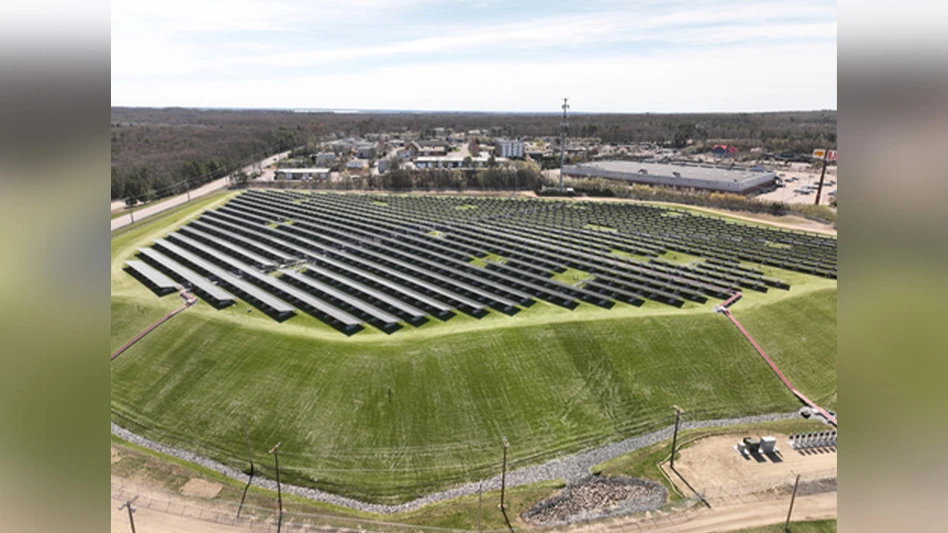
Houston-headquartered Waste Management has unveiled the latest technology in use at its Outer Loop Recycling and Disposal Facility in Louisville, Kentucky, turning waste from the landfill into renewable natural gas (RNG). This facility captures methane produced by the landfill, converting it to pipeline-quality natural gas.
The facility processes up to 5,000 standard cubic feet per minute (SCFM) of incoming landfill gas, according to the company. This equates to about 2,500 million British thermal units (MMBtu) of RNG daily, or 18,000 diesel gallon equivalents (DGE), enough to fuel about 800 of the company’s compressed natural gas (CNG) collection trucks.
“Waste Management’s innovative renewable natural gas facilities close the loop by converting discarded waste into beneficial gas that can go into the pipeline and fuel our very own CNG collection vehicles,” says Jim Trevathan, Waste Management executive vice president and chief operating officer.
The Outer Loop RNG facility serves as a model for a planned rollout of additional facilities in the coming years, the company says. WM also operates RNG facilities in Illinois (Milam Landfill) and Ohio (American Landfill).
RNG, or biomethane, is a pipeline-quality gas that is fully interchangeable with conventional natural gas and can be used in vehicles fueled by natural gas. RNG is the gaseous product of the decomposition of organic matter that has been processed to purity standards. Like conventional natural gas, RNG can be used as a transportation fuel in the form of compressed natural gas (CNG) or liquefied natural gas (LNG), WM says.
WM produces 16 million diesel equivalent gallons of RNG at its landfills with RNG facilities. The company says it uses the RNG to fuel a portion of its collection fleet, lowering fuel costs and reducing greenhouse gas emissions more than 80 percent compared with those powered by diesel.
WM’s 110 CNG stations deliver 60 million diesel equivalent gallons of natural gas each year. Its fleet of 6,700 natural gas trucks represents 30 percent of WM’s overall collection fleet. The company says it is committed to converting its fleet from diesel to natural gas, with 80 percent of new truck purchases powered by natural gas.
Including the company’s landfill-gas-to-energy facilities, WM says it has 130 projects at its landfills around the country producing the equivalent of more than 650 megawatts of capacity, which is enough to power 490,000 homes.
Latest from Waste Today
- Vermeer announces plan to build new facility in Des Moines metro area
- Buffalo Biodiesel shares updates on Part 360 application to DEC, Tonawanda facility progress
- Capstar Disposal expands roll off dumpster rental services
- Supreme Court strikes down IEEPA tariffs
- Casella details facility closures, expansion efforts
- Zero harm: Building a SIF prevention program for waste and recycling operations
- Casella posts a loss in Q4 2025
- McNeilus names Haaker Equipment first Dealer Partner of the Year