Together with renowned partners, Weltec Biopower in Vechta, Germany, is developing a test for identifying inhibitors in biogas substrates. Input mass may contain substances that prevent efficient biogas production. For example, a small amount of mold is sufficient to cause an adverse effect in silage. Ammonium, copper, zinc, drugs and disinfectants are often identified as inhibitors in slurry and manure. Traces of these substances are detrimental to the bacteria in the digester and counterproductive to the digestion process.
Since December 2016, Weltec is involved in a research project to establish a new procedure that will solve this problem. The project is subsidized by the German Federal Ministry of Food and Agriculture (BMEL) via Fachagentur Nachwachsende Rohstoffe e.V., an agency for renewable resources. In collaboration with HAWK, which is the Göttingen University of Applied Sciences and Art, Weltec is developing a procedure for identifying inhibitors in input substances.
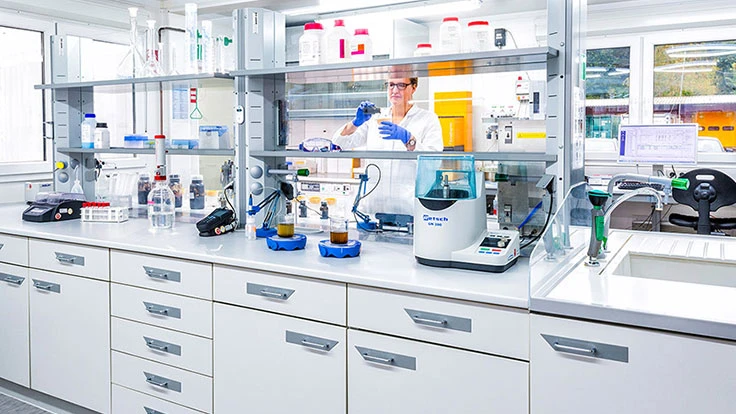
For this, various feedstocks are first examined in the Weltec lab in Vechta and at HAWK in Göttingen with the help of the Ankom system. This system is designed to deliver information on the gas production. The change of the acid spectrum is monitored while deliberately adding inhibitors. The resulting target curves will then be compared with the gas production curves of substrates. This comparison is to reveal whether the substrate contains any inhibitors. Previously, the aerobic four-plate inhibitor test used to be employed for identifying inhibitors, designed for the dairy industry and does not reflect the conditions in the digester, and the results are not as accurate. With the new anaerobic procedure, results are available after three days.
“The need and demand are on hand. Currently, there is no quick and reliable way to identify such potential process disruptions, though this would be vital to avoid unscheduled downtimes of biogas plants,” explains Sabine Lampe, graduate biologist and supervisor of the research project at Weltec Biopower.
“Based on this innovative procedure, biogas plant operators will be able to decide faster whether to buy offered silage or liquid manure or whether to use a certain batch of their own slurry,” Lampe continues. She adds that it would also be possible for substrate providers to use this quick test to furnish evidence of the quality of their product.
Since December 2016, Weltec is involved in a research project to establish a new procedure that will solve this problem. The project is subsidized by the German Federal Ministry of Food and Agriculture (BMEL) via Fachagentur Nachwachsende Rohstoffe e.V., an agency for renewable resources. In collaboration with HAWK, which is the Göttingen University of Applied Sciences and Art, Weltec is developing a procedure for identifying inhibitors in input substances.
For this, various feedstocks are first examined in the Weltec lab in Vechta and at HAWK in Göttingen with the help of the Ankom system. This system is designed to deliver information on the gas production. The change of the acid spectrum is monitored while deliberately adding inhibitors. The resulting target curves will then be compared with the gas production curves of substrates. This comparison is to reveal whether the substrate contains any inhibitors. Previously, the aerobic four-plate inhibitor test used to be employed for identifying inhibitors, designed for the dairy industry and does not reflect the conditions in the digester, and the results are not as accurate. With the new anaerobic procedure, results are available after three days.
“The need and demand are on hand. Currently, there is no quick and reliable way to identify such potential process disruptions, though this would be vital to avoid unscheduled downtimes of biogas plants,” explains Sabine Lampe, graduate biologist and supervisor of the research project at Weltec Biopower.
“Based on this innovative procedure, biogas plant operators will be able to decide faster whether to buy offered silage or liquid manure or whether to use a certain batch of their own slurry,” Lampe continues. She adds that it would also be possible for substrate providers to use this quick test to furnish evidence of the quality of their product.
Latest from Waste Today
- Vermeer announces plan to build new facility in Des Moines metro area
- Buffalo Biodiesel shares updates on Part 360 application to DEC, Tonawanda facility progress
- Capstar Disposal expands roll off dumpster rental services
- Supreme Court strikes down IEEPA tariffs
- Casella details facility closures, expansion efforts
- Zero harm: Building a SIF prevention program for waste and recycling operations
- Casella posts a loss in Q4 2025
- McNeilus names Haaker Equipment first Dealer Partner of the Year