Andrei Merkulov | stock.adobe.com
Woodchuck, an artificial intelligence (AI) platform focused on wood waste and biomass, has raised $3.75 million in seed funding led by an investor syndicate headed by Mason Fink. Additional partners include NorthStar Clean Energy, Alloy Partners and Beckett Industries.
“With this funding, we are accelerating our mission to help manufacturers and construction companies reduce waste, reduce costs and contribute to the clean energy grid,” Woodchuck CEO and Founder Todd Thomas says. “Every year, millions of tons of construction waste—much of it wood—are sent to landfills. Our AI technology allows us to extract value from this waste, turning it into clean energy and enabling our clients to achieve their sustainability goals.”
To mark its official launch, Woodchuck hosted a grand opening event at its headquarters in Grand Rapids, Michigan, attended by Gov. Gretchen Whitmer, local officials, business leaders and sustainability advocates. Woodchuck says the event highlighted Michigan’s growing leadership in clean energy innovation and showed how public-private collaboration can drive progress toward climate goals.
“We’re proving that sustainability and strong economic growth can go hand in hand,” Whitmer says. “We don’t have to choose between what’s right for the environment and what’s good for our communities. We can and must do both. And I think this is an example that we are up to the task in creating opportunity in the process.”
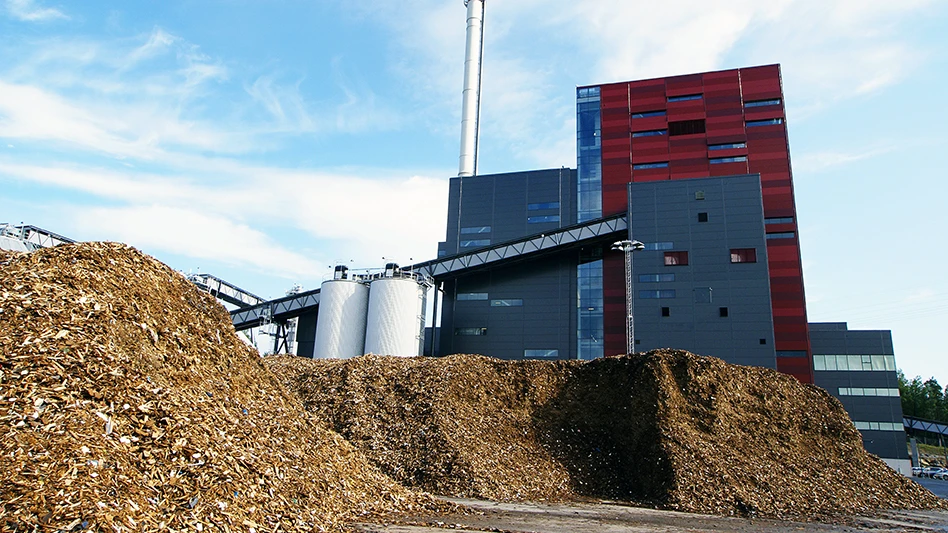
Woodchuck’s platform leverages AI to identify, sort and process wood waste, diverting it from landfills and converting it into biomass. By doing so, the company says it can help construction and manufacturing companies reduce waste-hauling costs by up to 30 percent.
According to Woodchuck, the AI platform integrates advanced image recognition to improve the efficiency and quality of biomass processing. The company says this reduces costs, enhances biomass quality and allows for broader applications of the resulting product in renewable energy generation.
"Big national construction companies are under increasing pressure to provide sustainable solutions to their clients,” Thomas says. “Our platform doesn’t just reduce waste—it validates and tracks every step of the process, giving clients a detailed report of the materials diverted, CO2 avoided and BTUs of clean energy produced. This transparency has been a game-changer for companies aiming to meet sustainability requirements.”
Woodchuck also supported disaster recovery efforts after a major ice storm hit northern Michigan, leaving behind extensive wood debris. The company says it is working with local municipalities and cleanup crews to safely and efficiently divert thousands of pounds of fallen timber and storm-damaged wood from landfills and into biomass processing. By turning storm debris into renewable energy, Woodchuck says it is demonstrating how climate resilience and sustainable innovation go hand in hand.
The company says it is committed to scaling its operations to meet the needs of construction, manufacturing and energy industries.
“Woodchuck represents a transformative platform at the intersection of sustainability and energy innovation,” says Mason Fink, head of the investor syndicate. “Their ability to convert waste into renewable energy or recycled content is not only solving environmental challenges but also setting a new standard for tech-enabled sustainability. We’re proud to partner with them as they redefine waste diversion and renewable energy.”
Woodchuck was launched in September 2024.
Latest from Waste Today
- Vermeer announces plan to build new facility in Des Moines metro area
- Buffalo Biodiesel shares updates on Part 360 application to DEC, Tonawanda facility progress
- Capstar Disposal expands roll off dumpster rental services
- Supreme Court strikes down IEEPA tariffs
- Casella details facility closures, expansion efforts
- Zero harm: Building a SIF prevention program for waste and recycling operations
- Casella posts a loss in Q4 2025
- McNeilus names Haaker Equipment first Dealer Partner of the Year